The Illegal Market Has Tripled Since 2020: Why Are Regulatory Restrictions Not Enough?
 Bulgaria
The Bulgarian government has announced a complete ban on gambling advertising, but a new European analysis highlights another side of the regulatory debate: the risk that excessive restrictions on the licensed sector could drive some consumers towards the illegal market.
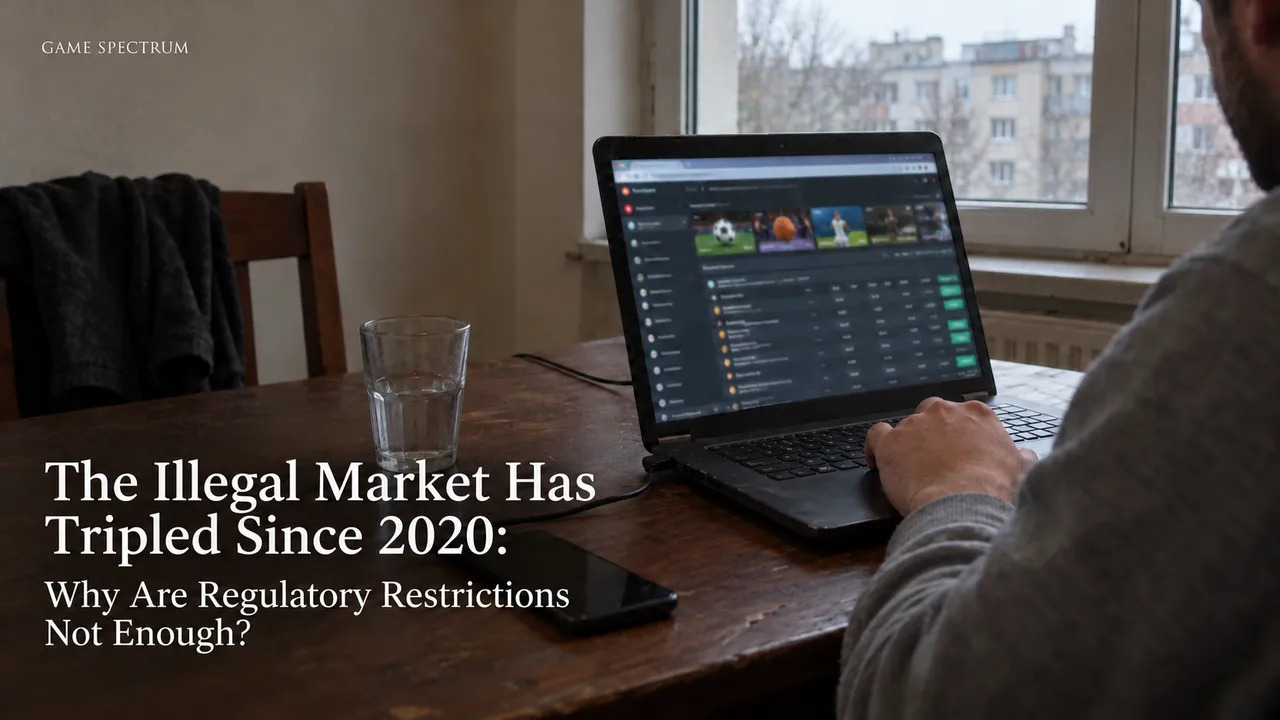
Europe’s online gambling black market is now estimated to be worth €12 billion annually. According to an analysis commissioned by the European Gaming and Amusement Federation (EUROMAT), published in September 2026 and cited by Focus Gaming News, this represents a threefold increase since 2020. The findings bring an increasingly pressing question into focus for European regulators: how effective are strict restrictions on the legal sector if unlicensed operators continue to expand their online presence and influence?
The study, commissioned by EUROMAT and conducted by Regulus Partners and Helios, estimates that the illegal online market generated €12 billion in net revenue in 2025, equivalent to approximately 25% of Europe’s online gambling sector. It covers 28 markets, including 25 EU member states, among them Bulgaria, as well as the United Kingdom, Serbia and Montenegro. The analysis draws on internet traffic, digital marketing and macroeconomic indicators.
Illegal Platforms Are No Longer on the Fringes of the Market
According to Focus Gaming News, the largest black-market operators are building recognisable brands and securing significant market shares, while illegal offerings are increasingly becoming a viable alternative for some online consumers.
The study’s authors link the growth of the unregulated sector to a combination of factors, ranging from the development of cryptocurrencies and affiliate marketing to regulatory measures that can make legal offerings less visible or inaccessible to certain consumers. The study does not claim that every such measure automatically expands the black market. It does, however, raise the question of how restrictions affect whether consumers remain within the regulated environment.
This points to a broader problem. Licensed operators pay taxes and fees and comply with consumer protection rules, while illegal websites operate outside that framework. When someone moves to an unlicensed platform, they are doing more than simply changing service providers. They also lose access to many of the oversight and protection mechanisms that the state requires legal operators to provide. That is where the real risk lies.
“Consumer protection policies are essential, but they become counterproductive if they end up driving players towards the black market,” warns Filip Jelavić, project lead at Helios, as quoted by Focus Gaming News. He adds that more engaged consumers who actively seek out illegal offerings are among the most vulnerable.
A similar trend is already emerging across several European markets: tighter restrictions on legal operators do not always produce the expected decline in gambling activity when unlicensed platforms remain readily accessible. Data from countries such as the Netherlands and Sweden suggest that this imbalance can erode the regulated market’s share. This places greater emphasis on practical measures targeting the black market itself, including access, payments and distribution.
Regulation Is a Particularly Timely Issue for Bulgaria
Since 2024, gambling advertising in Bulgaria has been significantly restricted on television, radio, in print and electronic media, and in a range of public spaces. A further step affecting the online environment followed in 2026, when legislation introduced a licensing regime for affiliate operators. The regulatory debate intensified on 23 September 2026, when Prime Minister Rumen Radev announced plans for even stricter rules for licensed operators and a near-total ban on gambling advertising in the country, with the proposals due to be published for public consultation.
The announcement comes at a time when European data are raising increasingly pressing questions about the impact of restrictions on the licensed sector. Reducing the visibility of legal operators does not, in itself, mean that demand will disappear. If unlicensed websites remain easy to find and use alongside those restrictions, some gambling activity could shift outside the regulated environment.
This is where EUROMAT’s analysis adds an important dimension to the Bulgarian debate. The study does not claim that advertising restrictions automatically fuel black-market growth. It does, however, question how effective regulation can be if it tightens conditions for licensed companies without making an equally strong effort to restrict access to illegal operators.
The Association of the Gaming Industry in Bulgaria (AGIB) also identifies tackling the illegal sector as a key issue for the market. It has previously highlighted the importance of better consumer awareness and coordination between the industry and public institutions.
“The growth of the illegal market in Europe and Bulgaria shows that effective regulation cannot rely solely on restrictions on the licensed sector. Parallel action is needed against unlicensed operators: restricting access and payments to them, and providing consumers with clear information on how to distinguish between legal and illegal gambling environments,” AGIB said.
Against this backdrop, the proposal for a complete advertising ban announced on 23 September makes the issue even more relevant to Bulgaria. If new restrictions further reduce the visibility of licensed operators without a corresponding strengthening of measures to block illegal websites, restrict payments to them and curb their digital reach, there is a risk that some consumers will be steered towards the very environment where oversight and protection are weakest.
EUROMAT’s new study brings the European debate back to this central issue. With the illegal market estimated at €12 billion and accounting for approximately a quarter of the online sector, the question is no longer simply how many restrictions can be imposed on licensed operators. It is also whether governments have sufficiently effective tools to tackle those operating outside the regulated market. In this context, further tightening of Bulgaria’s regulatory framework without equally vigorous action against the illegal sector could fail to solve the problem and create conditions for it to worsen.



 Czechia