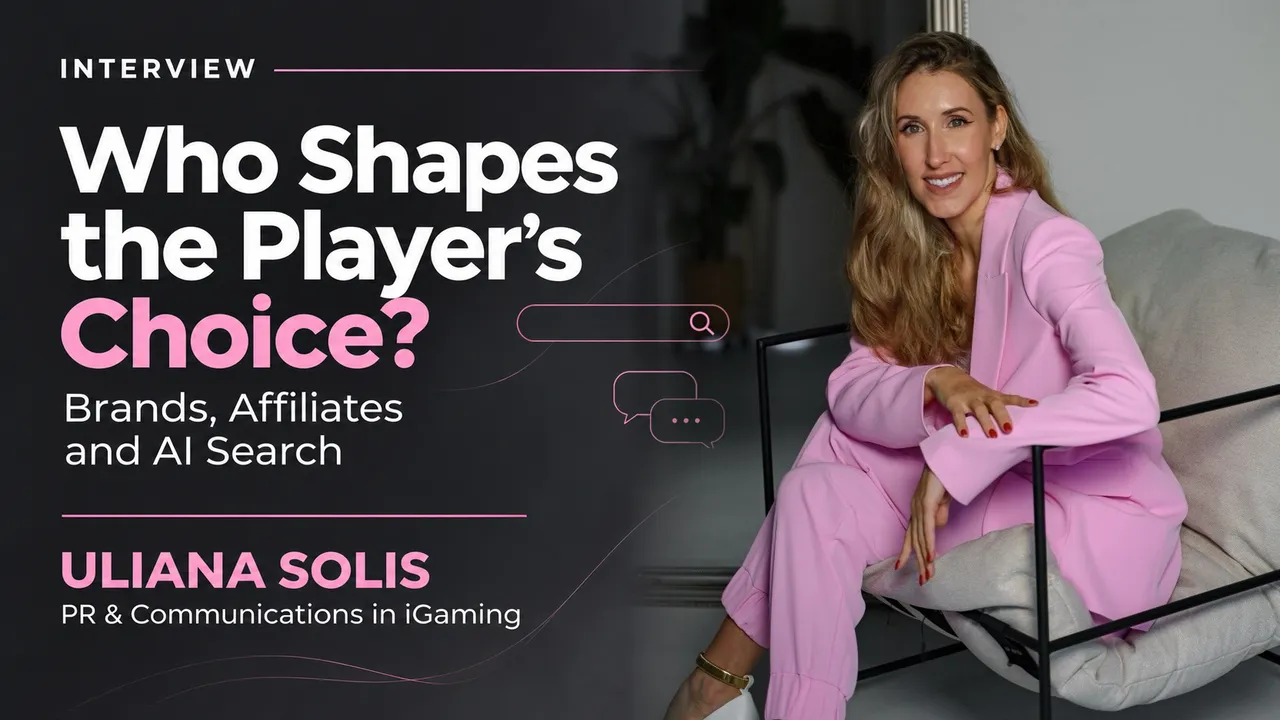
Who Shapes the Player’s Choice? Uliana Solis on Brands, Affiliates and AI Search
 Bulgaria
A player may form an opinion about an iGaming brand long before reaching its website - or an affiliate’s review. Between creator communities, peer recommendations and AI-generated answers, the opportunities to influence that opinion are becoming more dispersed. For operators and affiliates, this raises questions about whose judgment carries weight, how credibility is earned and whether the available data captures what drives a player’s choice.
Uliana Solis is a brand partnerships and PR professional with nearly a decade of experience across iGaming, gaming and digital entertainment. Her work spans sponsorships, commercial activations and communications, with a focus on connecting brands with relevant partners and audiences. In this conversation, she explores how player discovery is changing, what affiliates need to demonstrate their value, and why visibility alone does not make a brand people deliberately choose.
Across your work in content, communications and affiliate partnerships, how has the way players discover and evaluate iGaming brands changed? Which developments are already influencing business decisions, and which are still more prediction than reality?
When I started in the industry, the path was pretty simple. A player googled something, landed on a review site, compared a few bonuses, and clicked. That was the funnel.
Now it's messier, and honestly more interesting. People hear about a brand from a streamer, check it on Reddit or in a Telegram chat, ask an AI assistant, and only then maybe visit a review site. Or they don't visit one at all.
What's already affecting real decisions? Falling organic traffic, for sure. Affiliates have felt it in their revenue, and you can see it in how deals are structured, with more hybrid and revenue share and less pure CPA. Operators have noticed that the players who stay don't always come from the channels that bring the most clicks.
What's still more prediction than reality is the idea that AI search will replace review sites tomorrow. AI referrals are under 1% of traffic for most sites, so on paper nothing has collapsed. But the change is already here, and it shows up somewhere else. Fewer people arrive at the old destinations at all. The click itself is disappearing, and traffic reports barely capture that.
If a player receives a comparison directly from an AI assistant rather than visiting several review sites, where is their trust being placed? What does that change for the operator and the affiliate whose work may have informed the answer?
At first glance, in the assistant. But if you look closer, they're trusting whatever sources the model decided were credible. The player may never see those sources, and that's the uncomfortable part.
For the operator, it means your reputation is being summarised by someone else, and you don't control the wording. If the information about you online is outdated, inconsistent or thin, the answer will reflect that. That's why I keep saying it's a reputation issue, not only an SEO issue.
For the affiliate, it's a bit of a paradox. Their work may have shaped the answer, but they lost the visit. So the question for them becomes whether they're a source the model cites, and whether their name appears next to the answer. It’s hard to buy, and it comes from creating content people can actually trust and rely on.
That raises a question about the affiliate’s role. What do the strongest affiliates contribute that cannot be reduced to a ranking or a summary? How could that contribution become the basis of a more valuable relationship with their audience?
I'd start with what a ranking actually is. Most users already understand that positions on a review site aren't purely editorial. They're shaped by commissions, exclusive deals, hybrid contracts. That knowledge hasn't killed the format, but it has quietly changed how people read it. So a ranking tells you who is number one. The strongest affiliates have tested withdrawals themselves; they know which support team answers at 2 a.m., they remember which brand changed its terms last year and which one quietly fixed a payout problem. It's lived experience, and a summary can't fake it.
The best ones also have an audience that talks back. A YouTube community, a newsletter people actually open, a Discord where players argue about brands. That's a real relationship. So I see the value moving from being the page that ranks for a keyword to being the voice people return to on purpose. If an affiliate becomes a habit for their audience, AI doesn't replace them.
If affiliates develop that deeper relationship, how should their partnerships with operators evolve? Could an affiliate delivering fewer visitors - but more informed, deliberately interested ones - gain negotiating power, and what evidence would it need to demonstrate that value?
In theory, yes. In practice, not yet, because an affiliate can't prove it today.
Once the player clicks, the affiliate sees almost nothing. First deposit, maybe, and a monthly revenue number if they're on revenue share. Everything that matters after that stays inside the operator's CRM. So when an affiliate says “my players are high quality”, they're partly guessing.
That asymmetry has to change for partnerships to evolve. Operators say they care more about long-term player value than the first deposit, so affiliates need to see what that looks like.
In the short term, an affiliate's leverage comes from asking for the right numbers. Cohort retention at 30 and 90 days, and player lifetime value, on agreed terms. Whoever gets that access first is the one who can actually negotiate on quality instead of volume.
And there's another shift that I find pretty interesting, even though it's still early. Some affiliates have started limiting how many operators they work with, and choosing partners based on whether the brand could damage their own reputation. Not on who pays the most. Because at this point the affiliate's most valuable asset is trust, and one bad operator on their list costs them more than the commission brings in. It makes the relationship healthier on both sides. But these are still exceptions. Most of the market keeps listing everyone. Still, I think this is where it's going.
This brings us to reputation. Being frequently mentioned, being recommended and being trusted are three different things. How should an iGaming business distinguish between them when deciding where to invest - and how can it tell whether recognition is actually influencing someone’s choice?
This is one of my favourite topics, because people mix them up all the time.
Being mentioned is visibility. Press releases, logos at events, sponsored lists. It's easy to buy and easy to count, which is why companies love it.
Being recommended is when someone with credibility points to you. An affiliate, a journalist, a creator, or an AI answer that names you in the right context.
Being trusted is when people choose you and come back without being pushed. That's the hardest one, and the only one that pays off over time.
But the right metric depends on who you actually need to believe in you. For a B2C operator, reputation lives with the player, so sentiment, branded search, and retention by channel tell you whether recognition is turning into choice. For a B2B supplier, the audience is different; it's operators, investors, and talent. There, visibility in trade media and conference presence genuinely move the needle. So I'd never judge a B2B company by player-facing metrics or vice versa. It's the wrong yardstick.
And timing matters too. Sometimes a company just needs visibility, for example before a funding round or an acquisition, and there's nothing wrong with prioritising that for a quarter. The mistake is doing it permanently and calling it reputation work.
You have worked across content, communications, brand strategy and partnerships. Where do the priorities of those functions come into conflict when a company tries to build both immediate acquisition and lasting credibility? Which decisions need to be made jointly for the strategy to hold together?
Mostly over time horizons. Acquisition wants results this month. Brand and PR think in quarters and years. Content sits in the middle and gets pulled both ways.
A typical example: the partnerships team agrees to an aggressive promo with an affiliate, and it works for the numbers. But the messaging contradicts the positioning the PR team spent months building. Or the content team writes for keywords, while the brand tries to sound like an expert. Nobody is wrong individually. They just aren't aligned.
The decisions that have to be made jointly are pretty basic, to be honest. Who we're for and who we're not for. What we will never promise. Which partners represent us, and how. And what success means beyond financial goals. If those four things are agreed at the top, the teams can argue about tactics and the strategy still holds.
An established brand can draw on years of coverage, customer familiarity and partnerships. Where does that leave a newer business with a strong product but a limited public record? What could allow it to earn authority on its own terms rather than simply trying to match the incumbent’s volume of content?
In a better place than it looks. Established brands are locked into their own reputation, so experimenting is slower and riskier for them. A small brand has the freedom to try things, see what lands, and adjust quickly.
What that looks like depends on who you need to convince. For a B2B brand, it's proof: a well-documented pilot with real numbers, a client willing to speak on the record, a visible presence where the industry talks. One solid project does more than a year of content.
For a B2C brand, nobody reads case studies, so it's about creativity and participation. Livestreams where the audience tests the product with you, a community that gets a real answer when something goes wrong. Campaigns also matter here, and the best ones get players creating content about the brand themselves, because a clip from another player does more than any brand page. People trust what they've watched happen.
Either way, don't try to match the incumbent's volume. Be sharper, and let the reputation grow from that.
Looking two years ahead, what would convince you that a company had successfully adapted to this changing path to the player? Which business results would you look for - and what finding would make you reconsider your own view of where the industry is heading?
I'd look at a few things. Retention by acquisition channel. A growing share of branded and direct demand. Deeper partnerships with better player value. And whether AI assistants describe the brand accurately and in the right context, without the company having to push for it.
Probably the strongest sign would be a company that cut bonus spend and didn't lose players. That would mean they're winning on product, speed, and trust, which is where regulation is pushing the industry anyway.
What would make me reconsider? If the data showed that AI answers barely affect choice, and players still go mostly by the biggest bonus and the loudest brand. Or if brands with weak reputations kept growing just as fast as trusted ones. Then I'd have to admit that trust matters less than I think, at least in the short term. I don't expect that. But I'd rather keep checking than just assume I'm right.
 Netherlands